

How child sponsorship helped Feremusu’s family to break the free from poverty
June 9, 2025
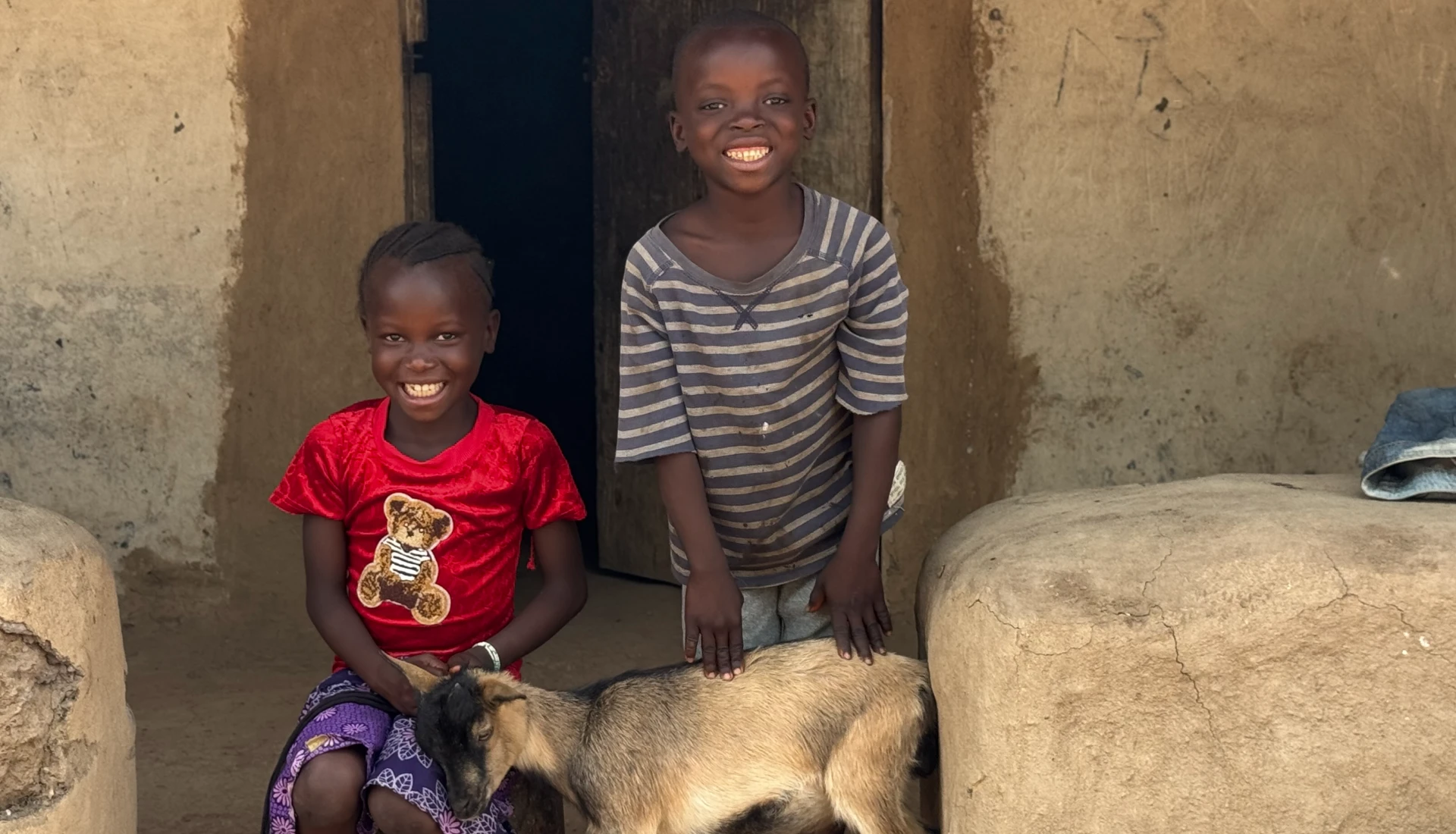
Feremusu and her brother, Lansana and one of their goats
Koinadugu District, one of Sierra Leone’s most rural and underserved regions, faces persistent cycles of poverty that severely limit children’s access to education. Families, struggling to meet their most basic daily needs, often cannot afford school fees, supplies, or transportation. In these conditions, education is not seen as an attainable right but as a distant luxury.
In particular, children like 7-year-old Feremusu are at risk of being left behind, forced to forgo school and contribute to their family’s survival instead. Limited livelihood opportunities, dependence on subsistence farming, and lack of access to sustainable income sources leave families vulnerable to shocks such as illness, food insecurity, and economic downturns.
Without targeted support and income growth, parents are often forced to make heartbreaking decisions: prioritizing immediate survival over long-term investments like education. This keeps family’s poor for generations and stops children from getting the chance to learn, grow, and have a better life.
Feremusu once faced a future without education, opportunity, or hope. Her family struggled each day to meet even the most basic needs. Going to school felt like an impossible dream.
Then something life-changing happened: Feremusu was matched with a sponsor from The United States of America through ChildFund. Fatmata, Feremusu’s mother, received some funds from her sponsors and she made sure it grew.
Rather than spend the support quickly, Fatmata made a courageous decision: she invested it. She bought a few sheep, goats, and chickens. This humble beginning blossomed into a critical lifeline for her family. Today, they proudly care for five goats and two sheep – small animals, but priceless in rural Sierra Leone.
And when a crisis struck, that investment saved a life.
When Feremusu’s twin brother, Lansana, suddenly fell gravely ill with chronic malaria, Fatmata faced every mother’s worst nightmare, with no cash on hand and her husband away.
“My husband was out of town when Lansana fell seriously ill. I had nothing left in my hand in the way of cash,” she laments. “I was left with two options. To sell one of the ruminants and get my son the much-needed treatment, or risk it until something terrible happens to him. So, I decided to sell one mature sheep for six hundred leones (LE 600) ($36).

That one sheep paid for Lansana’s treatment, and still, Fatmata managed to stretch the blessing even further. With the remaining NLE 400 ($24). She bought school shoes, bags, books, and pens for both Feremusu and her brother.
Through ChildFund’s support and Fatmata’s determination, one small gift became a lifeline for an entire family. “Now things have improved,” Fatmata reflects. “I could never afford to send my children to school before. With this help, my children are now in school.”
Today, Feremusu and her brother take pride in their new sense of responsibility. The twins have become partners in caring for the animals that now help sustain their family’s future.
“My brother and I look after our ruminants every day after school,” Feremusu shares with a shy smile. “Sometimes we feed them, give them water to drink, and sometimes even a little salt. In the evenings, we gently lead them back to their pen. In the mornings, it’s our mom or dad who helps them graze properly.”
In Koinadugu, interventions that combine child sponsorship with livelihood strengthening, like small-scale livestock farming, are crucial. They help families stabilize their incomes and ensure children can attend school, access healthcare, and develop the skills they need to break the cycle of poverty.




Related Resources

Meet the farmers uniting against child labor in Koinadugu
Rugiatu, Saran, Kumba, and Adama are cassava farmers and mothers living in Koinadugu District. Like...

How sponsorship transformed the life of Sirah and her family
Eighteen-year-old Sirah grew up in Bombali District in northern Sierra Leone, where life revolved around...
Sponsorship is transforming children’s lives in rural Koinadugu and BombaIi
ChildFund's sponsorship program is assisting children and young adults across Sierra Leone to continue and...