Community Action for Protection and Education (CAPE) Project
In parts of Koinadugu District, children face a range of challenges that undermine their growth, development, and overall well-being, including child labour, teenage pregnancy, early marriage, female genital mutilation/cutting (FGM/C), school dropout, school-based violence, and poor sanitation in schools. These interconnected issues demanded an integrated, community-driven response.
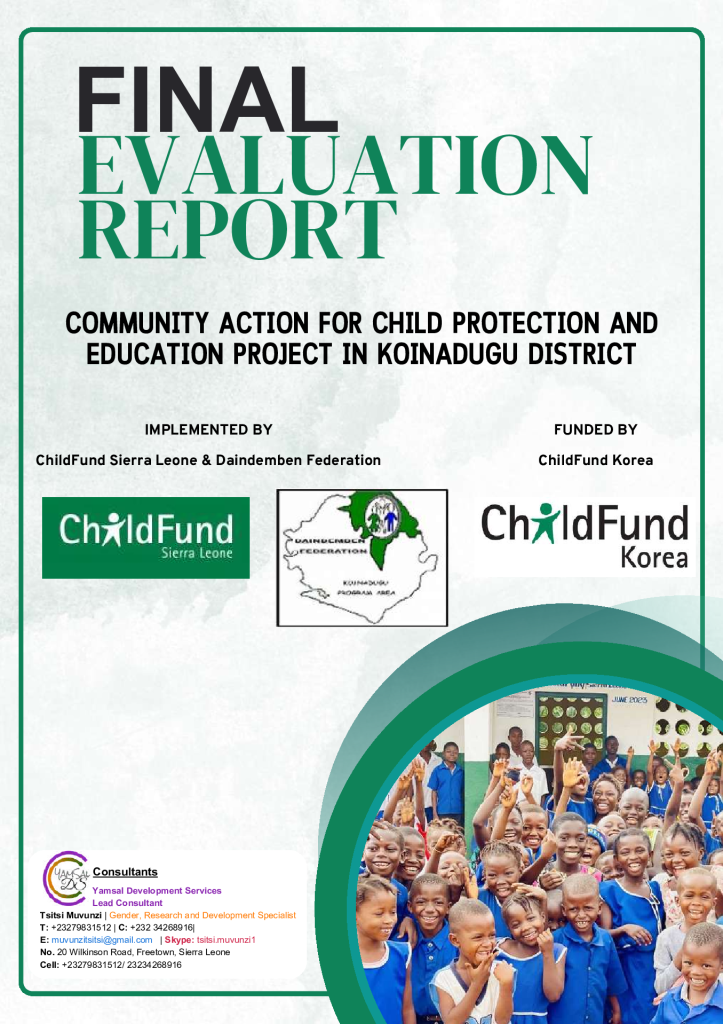
To address these barriers, ChildFund Sierra Leone, in partnership with Daindemben Federation, implemented the Community Action for Child Protection and Education (CAPE) project. The initiative combined multiple sectors—child protection, education, reproductive health and rights, family economic empowerment, water, sanitation and hygiene (WASH), and renewable energy (solar electrification)—into one cohesive approach.
By strengthening existing community structures and promoting local ownership, CAPE ensured that children were protected not only from diseases and unsafe water, but also from physical, emotional, and sexual abuse. The project focused on both school and community environments, reinforcing safety, dignity, and opportunity for every child.
The overall objective of the action was to ensure that all children are protected from all forms of violence and fulfill their rights to live in a safe environment in Koinadugu district. This project will use the School Based Violence Prevention (now Education for Protection and Well-being) Model of ChildFund. This model considers schools as crucial players in addressing the root causes of violence, transforming harmful gender norms, and promoting prosocial behavior for sustainable community development.

For more information, visit: https://www.childfund.or.kr/eng/main.do
Role: ChildFund Sierra Leone provided funding for the project through its local partner, Daindemben Federation, and offered overall leadership throughout implementation. The organization was responsible for monitoring progress and reporting to the donor, ensuring transparency and alignment with project goals.
Role: The Ministry of Basic and Senior Secondary Education (MBSSE) provided overall approval for the implementation of the project and played an oversight role throughout its execution. The Ministry also facilitated the training of teachers, focusing on the Code of Conduct and positive classroom management practices to promote safer, more inclusive learning environments.
Role: The Ministry of Gender and Children’s Affairs provided strategic oversight in the implementation of the project in accordance with the strategic focus of the government. They were also responsible for monitoring the project for quality implementation. Facilitated training of community-based child protection structures.
Daindemben Federation

Role: Daindemben Federation was co-implementaters, responsible for District and community-based implementation of the project
Koinadugu District Council
Role: Provided approval for implementation of the project in the district, monitoring oversight during implementation for quality program delivery.
- Koinadugu
The project made meaningful improvements in education, hygiene, and child protection across target communities:
- Access to electricity: Provided USD 45,000 worth of solar power to benefit 939 students and teachers in 3 schools, enabling improved learning conditions and safety.
- Water and hygiene: Installed 3 rainwater harvesting systems in schools, supporting students to practice safe hygiene and handwashing.
- Improved sanitation: Constructed 6 gender-separated latrines across 3 schools, ensuring safe and dignified sanitation facilities for girls and boys.
- Menstrual hygiene management: Distributed sanitary pads to 366 girls across 5 schools to promote menstrual hygiene and reduce school absenteeism.
In partnership with Daindemben Federation, ChildFund also strengthened community-based child protection systems:
- Developed child protection action plans in 5 communities to address and prevent abuse, neglect, and exploitation.
- Trained 100 members (60 men and 40 women) of Community-Based Child Protection (CBCP) structures on child protection, psychosocial first aid (PFA), and referral pathways.
- Conducted community sensitization campaigns in all 5 project communities, raising awareness and building safer, more protective environments for children.
Latest News

Solar power delivers uninterrupted learning to Koinadugu students
Fifteen-year-old Mariama dreams of becoming a medical doctor. But in the remote...
Read More
ChildFund provides solar power worth USD 45,000 to 3 schools in Koinadugu
ChildFund, through its Light for Education (LIFE) Solar Electrification Project, provided and...
Read MoreRelated Resources

Contact Us
For more information, please write to:
SHARE VIA: