

KOICA and ChildFund launch an education project to support 3,300 out-of-school girls to access quality secondary education in Western Area
10/05/2023
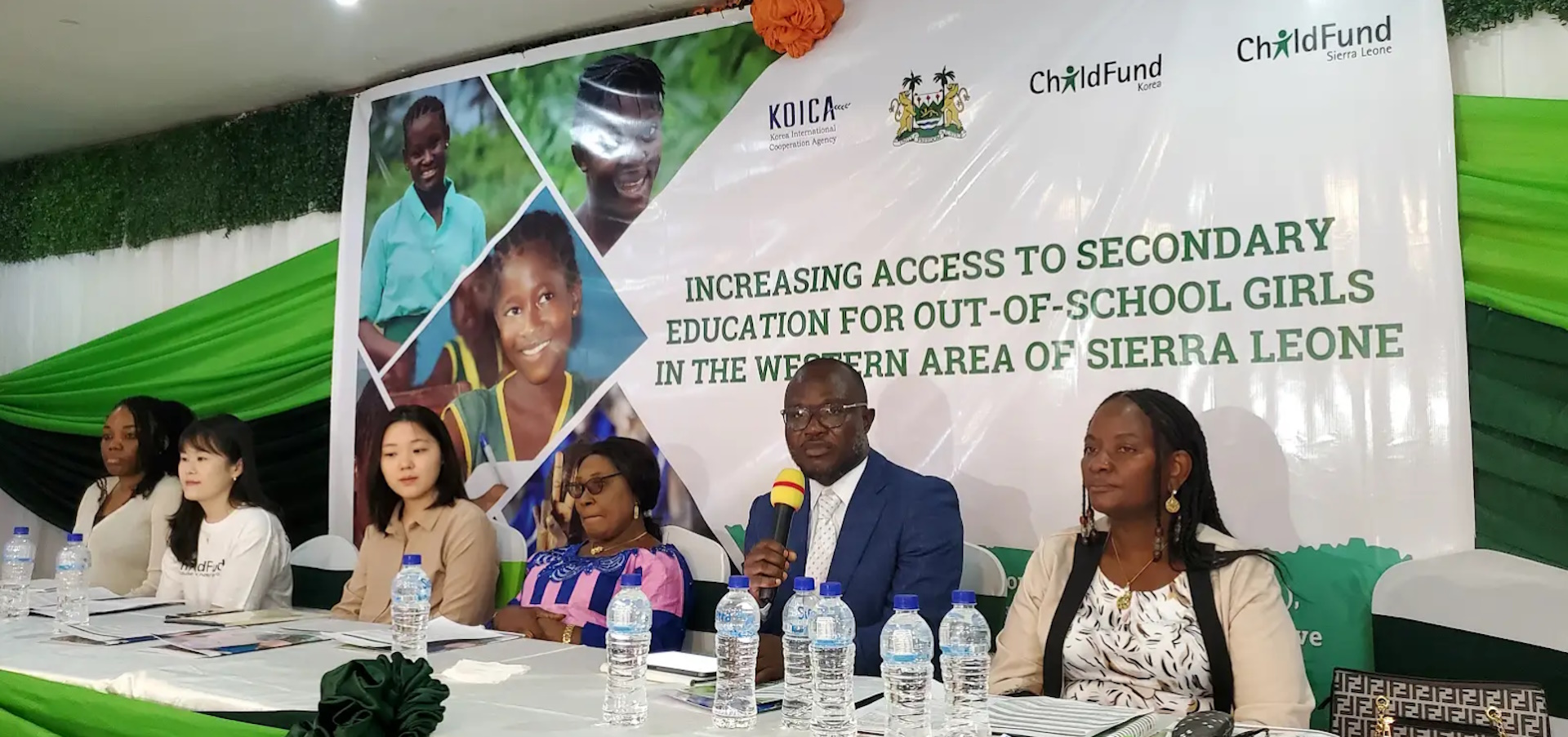
ChildFund, in collaboration with Korea International Cooperation Agency (KOICA), and the government of Sierra Leone, has launched a USD 1,555,000 education project to increase access to secondary education for 3,300 out-of-school girls in the Western area of Sierra Leone.
The three-year project (April 2023 – December 2025) will be implemented by ChildFund Sierra Leone in collaboration with the Ministry of Basic and Senior Secondary Education (MBSSE) in 6 schools in the Western Urban and Rural Districts.
Acknowledging educational challenges, such as the learning crisis, gender discrimination and the skills gap issue in developing countries, KOICA has set comprehensive targets that aim to cover quality and inclusive education initiatives, while also focusing on gender equity and the development of relevant skills. ChildFund Korea and ChildFund Sierra Leone have education as one of their key priorities for driving development.
This project, the first to be funded by KOICA in Sierra Leone, is geared towards ensuring that out-of-school girls have access to inclusive and safe learning environments; out-of-school girls are supported to continue their education, and communities are meaningfully engaged in the protection of marginalized children and enrolling them in schools.
“This project represents a critical milestone in our drive to provide quality education for every child – boy or girl, across the country,” said Emily Gogra – Deputy Minister of Basic and Senior Secondary Education. “This is in line with the government’s National Policy on Radical Inclusion in Schools to support girls who are or have been pregnant, and parent learners to stay in school; and the National Strategy for Out-of-School Children in Sierra Leone that targets to achieve zero out-of-school children in the country. We are grateful to KOICA and ChildFund for supporting this vision.”
Public school facilities in Sierra Leone are often overcrowded due to several factors. Knowing the challenges that out-of-school girls will likely face once admitted or readmitted to these already overcrowded schools, this project will augment school classrooms in the targeted schools and improve Water, Sanitation and Hygiene (WASH) facilities. This year, additional facilities will be constructed in 2 schools while the remaining 4 schools will be done in 2024 and 2025 respectively.
Apart from constructing additional school facilities, the project will also strengthen teachers’ capacities on various teaching and learning components, provide teaching aids and materials, conduct training on school-based violence prevention, provide learning materials for out-of-school girls, provide psychosocial and mentoring support for out-of-school girls who may face traumatic or psychosocial difficulties, provide childcare to assist adolescent mothers, advocate with local authorities on laws and policies protecting children, and implement advocacy and sensitization campaigns.
Furthermore, this initiative will support the establishment or re-activation of key committees such as Community Teachers’ Associations (CTAs), Parent Teachers’ Associations (PTA) and School Management Committees (SMC) and establish Male Action Groups (MAG) to advocate for child protection and universal education in the community, among others.
“KOICA is very proud to launch its first NGO project in Sierra Leone. This is a flagship project of the Development MOU that KOICA signed with the Government of Sierra Leone last year. I am confident that this project will serve as a driving force for Sierra Leone’s social development especially in the field of basic education.” says Hyesong Park, deputy country director of KOICA Nigeria office.
‘’For the very first time in history, KOICA is funding a project in Sierra Leone, through ChildFund Korea. This is a great opportunity for us as partners in this project to be able to contribute towards Sierra Leone’s development especially in the area of education,’’ says Jaeun Nam, Country Program Manager from ChildFund Korea.
According to a Purposeful Girls’ Circles baseline survey, ‘’…girls’ lives in Sierra Leone, especially those who are out of school, are characterized by multiple hardships: little to no education; the ubiquity of transactional sex; teen pregnancy; and everyday violence.’’
During the peak of the Ebola Virus Disease (EVD) in Sierra Leone in 2014-15, schools were closed for nine months to stop the spread of the disease, girls experienced even alarming school dropout rates as a result of teenage pregnancy, domestic violence, and sexual abuse. Adolescent pregnancy and child marriage in Sierra Leone are among the highest globally, and UNICEF cites that over the next decade, as many as 13 million more girls could be forced into early marriage by economically struggling parents.
“ChildFund is committed to advancing child rights around the world, with education as a top priority. For us to achieve zero out-of-school children in Sierra Leone, all education stakeholders, including the government, development partners, school authorities, children and adolescents, parents, teachers and communities, must work together to identify and enroll all children who are not in school and provide services to help children stay in school.’’ says Victor Kamara, ChildFund Sierra Leone’s Country Director. “From early childhood education to primary school and secondary school, getting children in class also requires us to tackle a wide range of hurdles including issues around affordability, quality of education, sanitation and hygiene, early marriage, low completion rates and the low level of foundational reading and numeracy,” he noted.
As of June 2025, the following have been achieved on the project:
-
- Four school buildings; (12-classroom blocks) constructed at the Sierra Leone Muslim Congress, Sengbe Pieh Memorial, Services and Fourah Bay College Junior Secondary schools in 2023 and 2024 have contributed significantly to increased school enrolment by 25% across the listed schools.
- 72,984 school pupils have access to improved Water sources, from which water is available because of the construction of 4 mechanized solar powered boreholes carrying 80,000 liters of water across the Sierra Leone Muslim Congress, Sengbe Pieh Memorial, Services and Fourah Bay College Junior Secondary schools.
- A total of 840 modern desks and chairs have helped create a more conducive learning environment across 12 newly constructed classroom blocks at Sierra Leone Muslim Congress, Sengbe Pieh Memorial, Services, and Fourah Bay College Junior Secondary Schools.
- A total of 72,984 school pupils now have access to improved basic sanitation services, including 16 compartments of sex-separated VIP latrines and 4 urinals. These upgraded facilities, located across Sierra Leone Muslim Congress, Sengbe Pieh Memorial, Services Secondary, and Fourah Bay College Junior Secondary Schools, offer usable single-sex toilets and basic handwashing stations, promoting better hygiene and dignity for students.
- Out of a total of 25 Out-of-School (OOSC) Girls that sat the Basic Education Certificate Examination (BECE) in 2024 school academic year, 23 passed with flying colors across the six schools and are continuing their senior secondary education.
- The 227 re-enrolled OOS girls have covered significant aspects of their school syllabus in just two years, helping the girls catch up on years of missed school and transition effectively into the formal school system across the 6 schools.
- A total of 441 Aki-Ola Series textbooks in Mathematics, English, Physics, and Chemistry have significantly enhanced girls’ reading and comprehension skills over the two-year implementation period. Additionally, students across the six schools are learning to resolve conflicts through mediation, led by Child Rights Clubs (CRCs), which are actively working to end school-based violence, eliminate gender discrimination, and promote self-protection among peers.
- 6 bye-laws enacted by Community structures to address school dropouts rates, promote gender equality and violence against children across the 6 schools/communities.
- 150 teachers are demonstrating increased knowledge on the teachers Code of Conduct, Radical Inclusion, Sexual and Reproductive Health issues for students across the 6 schools benefiting from the project.
- The establishment of Early Childhood Development (ECD) Centers in communities across four of the schools has played a key role in improving the retention of out-of-school (OOS) girls, as their children are safely cared for at these centers. Additionally, the provision of teaching materials—including chalk, A4 paper, whiteboard markers, school registers, textbooks, and files—has enhanced the teaching and learning environment, supporting educators in effectively delivering lessons.
SHARE:




About ChildFund
About ChildFund
ChildFund is a child-focused international development organization that works throughout Asia, Africa, and the Americas to connect children with the people, resources, and institutions they need to grow up healthy, educated, skilled, and safe. In Sierra Leone, ChildFund operates through three Local Partners (LPs) across 4 districts, reaching approximately 1.4 Million children, families, and community members. ChildFund implements programs in child protection, food security, livelihoods, early childhood development, education, and water, sanitation, and hygiene, among others.
Follow ChildFund Sierra Leone on: LinkedIn, X, Facebook, and YouTube
About KOICA
Korea International Cooperation Agency (KOICA) is a government aid agency of the Republic of Korea, founded in 1991. KOICA implements Korea’s grant and technical cooperation of the ROK, supporting the socio-economic development of many developing countries.
KOICA endeavors to combat poverty and support the sustainable socioeconomic growth of partner countries. By doing so, KOICA establishes and strengthens friendly ties with developing countries. Its mission includes promoting amicable and cooperative relations and mutual exchange by rendering support for the economic and social development of developing countries. With the vision of serving both domestically and internationally as a development cooperation platform contributing to accomplish the Sustainable Development Goals (SDGS).
About ChildFund Korea
ChildFund Korea is one of the most influential international nongovernmental organizations in the Republic of Korea working for the welfare of children. The organization has been working to protect children’s rights and help children suffering from poverty and disease for over 75 years. The scope of ChildFund Korea ranges from domestic to overseas; working in over 30 countries to help deprived, excluded and vulnerable children, families, and communities through meaningful, sustainable solutions.
ChildFund Korea focuses on advocacy activities to protect the rights of all children, strengthen welfare programs based on children’s rights under the UN Convention on the Rights of Children, actively respond to social issues, humanitarian aid, and other critical issues for children such as climate change, and strive to ensure children’s rights.
More to Explore

ChildFund Supports Families in Daru, Kailahun District After Devastating Floods
ChildFund Sierra Leone provided urgent food relief to over 150 flood victims...

Launch of Cassava Value Chain Project Marks New Era for Rural Farmers and Child Protection in Bombali, Koinadugu and Falaba Districts
A new chapter has begun for farming communities across Sierra Leone’s Koinadugu,...
ChildFund International CEO Visits Sierra Leone, engages youth and high-level development partners
The President and Chief Executive Officer (CEO) of ChildFund International, Isam Ghanim,...