

Parental involvement in education boosts learning in Bombali
June 5, 2025

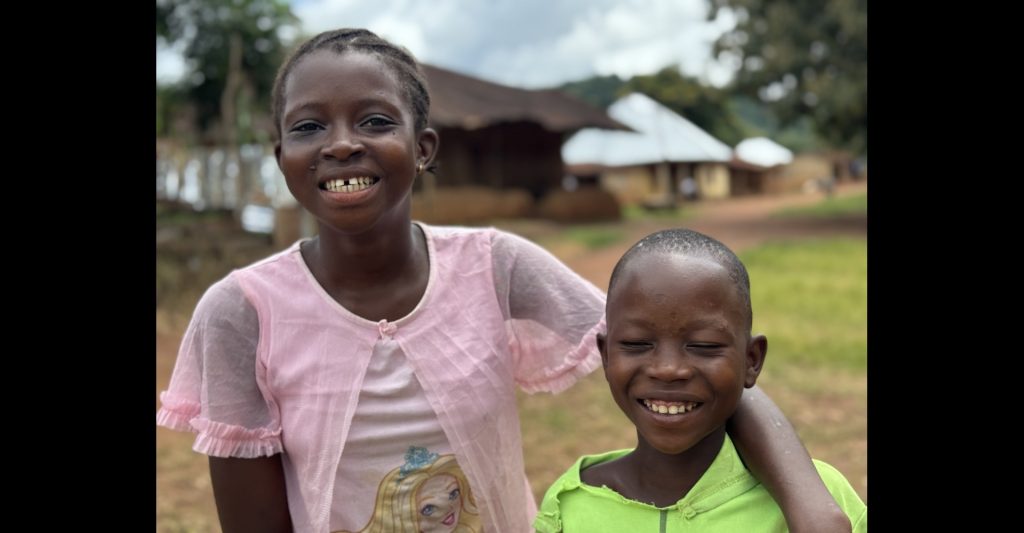
Hulaimatu.
Hulaimatu’s life is changing in ways she never thought possible. Once, the idea of her mother visiting her school to check on her progress seemed like a distant dream. Parents in her community rarely had the time, or the understanding, to prioritize their children’s education and well-being beyond ensuring they left home for school each day.
When parents don’t visit schools, it can hurt their children’s learning, behavior, and growth. It may create a gap between home and school, making it harder for teachers and parents to communicate and support the child properly.
The Education for Protection and Well-being (EPW) Program
ChildFund started implementing the Education for Protection and Well-being (EPW) program model in Hulaimatu’s community in Bombali District. Delivered through schools, EPW targets teachers, caregivers and school-aged children to cultivate physically, emotionally and psychologically healthy environments for children’s well-being and education. The program combines cognitive-behavioral skills training for teachers and caregivers and social-emotional learning and self-protection activities for children.
Four components, targeting children, caregivers, teachers, and the school/family work in partnership to build social cohesion, enhance teaching practices, positive parenting, and parental engagement in education, break the continuum of violence, and improve educational outcomes for children. The program aims to strengthen child-adult relationships, reduce violence and create safe, nurturing environments both at school and at home. EPW further helps strengthen their social-emotional skills and their ability to protect themselves from violence.
‘’The session I like about the program is the social emotional learning which teaches me how to live with the elderly at home and how to behave at school.’’
Huliamatu’s Mother is Now Involved in her Daughter’s Education

But now, the 11-year-old is experiencing a new normal. Through the EPW initiative, her mother has not only started visiting her at school but actively inquiring about her progress, her safety, and her overall learning experience. ‘’Now, with the EPW teachings, I share things in common with my classmates. We talk and advise one another. I advise my colleagues to do the right thing, and if they don’t I report to the teacher,’’ she mentions.
For Hulaimatu, these visits mean the world. They are more than just check-ins, they are affirmations of her value and her mother’s growing involvement in her life. “Before this time, my mother never really asked how I was doing at school,” she shared,” and furthered, “She just asked me to dress up in the morning and go to school. Whether I get to school or not, she wouldn’t know. Now, I know my mother cares about how I’m learning and feeling.”
Hulaimatu’s mother, Fanta, acknowledges that many parents, including herself, were not fully engaged in their children’s education. “Most of us weren’t checking on our children. We didn’t bother to find out whether they actually went to school or skipped classes,” she admitted. “But thanks to this program, that’s changing. Parents like me are now more involved and making an effort to follow up on their children’s schooling. I didn’t even know my child’s class teacher, but now, I do.”
“The EPW model has strengthened the bond between teachers and students by reinforcing our responsibilities as educators,’’ said Teacher Musa Conteh, Hulaimatu’s class teacher. “Through its dedicated form for registering children who participate in the sessions, we have become more attentive to school attendance. It’s helping us track which students are coming to school and actively participating in class, allowing us to better support their well-being and learning.”

Changing Parental Attitudes
When parents visit their children at school, it helps build a strong connection between home and learning. This leads to better grades, higher test scores, and important skills like time management and self-discipline. Children with involved parents attend school more regularly, stay motivated, and develop a positive attitude toward learning. Parent involvement also boosts confidence, improves social skills, and helps children feel included and supported. By staying in touch with teachers and taking part in school activities, parents create a positive learning environment that helps their children succeed in both school and life.
ChildFund’s EPW Model targets children ages 6-12, their teachers and their caregivers, over a two-year period in schools. The program places a strong emphasis on improving relationships within and between levels of the ecological model among children, caregivers, and teachers.
The program has reshaped the relationship between parents and children, creating an environment where education is a shared family priority. For Hulaimatu and many like her, it’s a powerful shift, one that ensures children feel protected, supported, and seen both in and out of the classroom.




Related Resources
Play based learning helps children see teachers as friends, not figures to fear
For 12-year-old Mabinty, starting Class 5 at a new school in a larger town was...
Six months on: ChildFund and KOICA review gains of girls’ education project in Sierra Leone
Six months after the completion of a transformative education initiative, ChildFund and the Korea International...

Meet the farmers uniting against child labor in Koinadugu
Rugiatu, Saran, Kumba, and Adama are cassava farmers and mothers living in Koinadugu District. Like...